At a glance
- Year: 1968
- Location: Amsterdam
- Story status: Confirmed
A Strategic Rivalry
By the mid-twentieth century, the Dutch brewing industry was dominated by two major names: Heineken and Amstel.
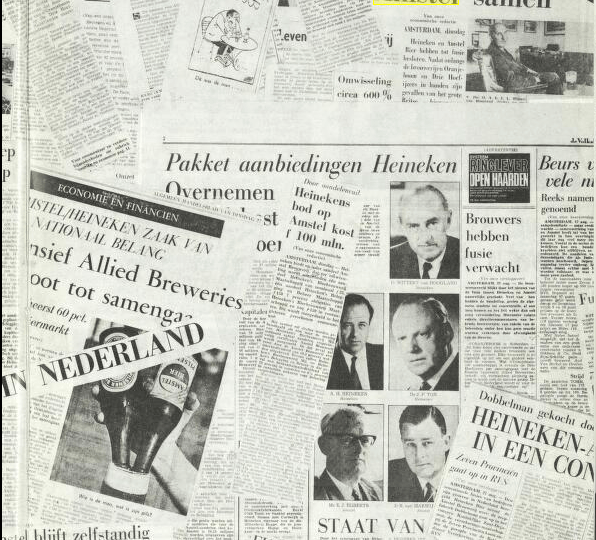
Both breweries had expanded significantly since the early twentieth century and had developed strong reputations domestically and abroad. While Heineken had focused heavily on international export markets, Amstel had built a substantial presence of its own, including brewing partnerships and production agreements across several continents.
Despite their shared Dutch roots, the two companies were long considered direct competitors, particularly within the Netherlands.
Yet by the early 1960s, the brewing industry was entering a new phase.
The Pressure of a Changing Market
Across Europe, economic integration and technological progress were reshaping industrial sectors. The formation of the European Economic Community (EEC) encouraged companies to expand and compete on a continental scale.
For breweries, this meant that size increasingly mattered.
Larger production volumes, wider distribution networks, and stronger capital reserves were becoming essential for competing internationally. Smaller or fragmented national industries risked being overtaken by larger brewing groups emerging elsewhere in Europe.
Within this environment, the leadership of Heineken’s Bierbrouwerij Maatschappij N.V. and Amstel Brouwerij N.V. began quietly evaluating the future of the Dutch brewing industry.
The First Proposal — 1963
On 26 August 1963, the boards of both companies issued a formal announcement stating that they had been studying developments in the brewing sector and considering whether closer cooperation might be beneficial.
The statement emphasized several factors:
- the increasing scale of industrial production
- the economic integration taking place within the EEC
- the advantages that a larger brewing enterprise could provide in global competition
The boards therefore proposed a structure through which Amstel shareholders could exchange their shares for shares in Heineken, effectively combining the two companies while preserving their individual brands.
At the time, however, the proposal did not immediately lead to a merger.
Freddy Heineken’s Reluctance
One of the most influential voices within the company was Alfred H. “Freddy” Heineken, who had become increasingly involved in the strategic direction of the brewery.
Freddy initially viewed the prospect of absorbing Amstel with caution.
He believed strongly in the distinct identity and reputation of the Heineken brand, which had been carefully cultivated since the nineteenth century. A merger with a major domestic competitor raised concerns about brand dilution and organizational complexity.
For several years, discussions continued while the companies remained separate.
A Changing Strategic Reality
By the later 1960s, however, the brewing landscape had shifted further.
International competition was intensifying, and consolidation within the European brewing sector was becoming increasingly common. The possibility that Amstel might align with other brewing interests also posed a potential strategic risk.
Under these conditions, the earlier proposal began to appear less like an option and more like a necessity.
In 1968, Heineken moved forward with the acquisition of Amstel Brouwerij N.V., bringing the two historic Dutch breweries under a single corporate structure.
Immediate Global Consequences
The acquisition had effects far beyond the Netherlands.
Through Amstel’s existing international relationships, Heineken gained connections to breweries and distribution networks in several regions, including:
- Suriname
- Curaçao
- Jordan
- Lebanon
- Greece
- Madagascar
These links provided new opportunities for expansion and strengthened Heineken’s emerging position as a global brewing company.
At the same time, both Heineken and Amstel brands continued to exist, allowing the group to serve different markets with distinct identities.
A Defining Moment in Dutch Brewing
The integration of Amstel into the Heineken group marked one of the most significant restructurings in the history of the Dutch brewing industry.
What had once been a rivalry between two national brewers became the foundation of a larger international enterprise.
The decision also demonstrated a broader shift taking place across European industry during the 1960s: companies were no longer competing only within national markets, but increasingly within a global economic system.
For Heineken, the acquisition of Amstel was not merely a takeover.
It was a turning point that helped transform the company from a successful exporter into one of the world’s leading brewing groups.
Sources & Archival References
Primary documents:
- Board announcement of Heineken’s Bierbrouwerij Maatschappij N.V. — 26 August 1968
- Board announcement of Amstel Brouwerij N.V. regarding cooperation with Heineken
- Heineken corporate yearbooks (1960s)
Secondary sources:
- Historical overviews of Heineken’s international expansion
- Dutch brewing industry archives