At a glance
- Year: 1877
- Location: Rotterdam
- Story status: Confirmed
Brewing Needed Cold — But Cold Was Unreliable
By the 1870s, Heineken had fully committed to bottom-fermented lager brewing. This method produced a clearer, more refined beer, but it came with one strict requirement: stable, low temperatures during fermentation and storage.
For centuries, brewers relied on winter ice harvested from canals and lakes. The system worked — but only when nature cooperated.
As production expanded and exports increased, relying on natural ice became increasingly risky. Warm winters, transportation delays, or shortages could threaten entire brewing cycles.
For a brewery built on consistency, this uncertainty was unacceptable.
The Rotterdam Breakthrough
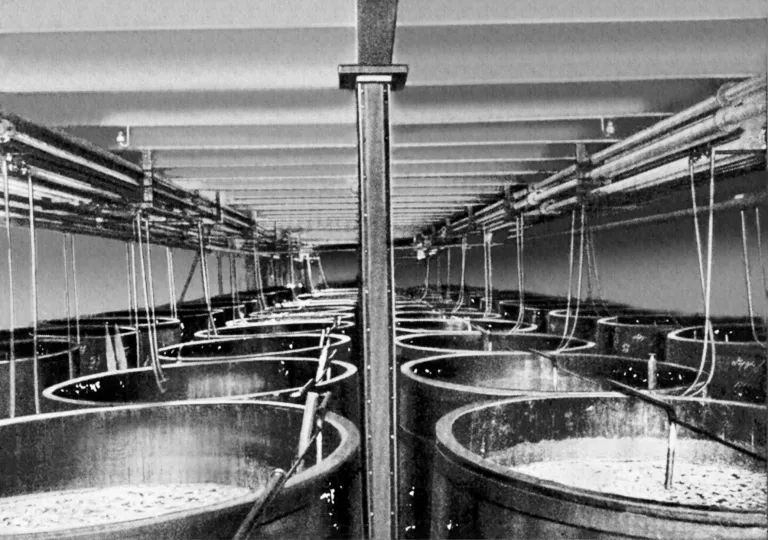
In 1877, the Heineken brewery in Rotterdam — under director Feldmann — took a decisive step forward. The brewery ordered an ice machine, marking one of the early transitions toward controlled mechanical cooling in brewing.
Working through intermediary Gabriel Sedlmayr, Heineken entered collaboration with German refrigeration pioneer Carl von Linde, one of the leading engineers transforming industrial cooling technology at the time.
Linde developed an innovative system known as natural convection cooling, using networks of cooling pipes installed along cellar ceilings. Cold air circulated downward through the fermentation rooms, maintaining stable brewing temperatures regardless of season.
For the first time, temperature control could be designed rather than hoped for.
Brewing Science Becomes Industrial Precision
Mechanical cooling did more than improve reliability. It allowed brewers to extend production throughout the year, removing the traditional seasonal limitations of lager brewing.
Fermentation could now proceed under carefully controlled conditions. Storage temperatures became predictable. Beer quality became more consistent from batch to batch.
This was not simply an equipment upgrade. It represented a fundamental shift in brewing philosophy — from adapting to nature toward mastering it through engineering and science.
A Network of Brewing Innovation
The influence of this development quickly spread beyond Heineken itself. Feldmann later introduced Carl von Linde to J.C. Jacobsen of the Carlsberg Brewery in Copenhagen, helping accelerate refrigeration adoption across the European brewing industry.
The exchange of knowledge between pioneering breweries reflected a growing international brewing culture built on scientific collaboration rather than secrecy.