At a glance
- Year: 1975
- Location: Zoeterwoude
- Story status: Confirmed
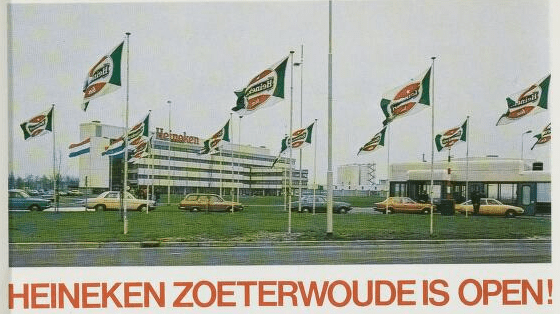
Heineken Zoeterwoude Is Open! (18 April 1975)
Some breweries just start production quietly one Tuesday morning. This one got over 5,000 guests, hundreds of flags, a royal visit, a brass band, and its own miniature golden cradle.
On 18 April 1975, the brand-new Heineken brewery in Zoeterwoude officially opened its doors — the culmination of a project that had been eighteen months in active preparation, and years in the planning before that. The site, cheerfully nicknamed the “Barrepolder” by locals (and, per the mayor’s own joke that day, sometimes affectionately mangled into “Bierpolder” — beer polder), was dressed for the occasion with flags as far as the eye could see.
Not Enough Room in Rotterdam
To understand why Zoeterwoude exists at all, you have to go back to 1969, when Heineken’s board made a call that would reshape the company’s entire Dutch production footprint: Rotterdam’s century-old brewery had to go.
It wasn’t for lack of affection. The original plan had actually been to renovate and expand right there on the existing Rotterdam site. But the numbers didn’t work. Rotterdam’s brewery sat on barely 4 hectares — nowhere near enough room for a facility built to the scale modern brewing now demanded — and expanding in place meant fighting an increasingly congested city, both for traffic and for environmental reasons. The era of squeezing a growing brewery into an old city footprint had run its course.
So Heineken went looking for somewhere with actual room to grow — and found it in the flat, quiet polder land near Zoeterwoude, right in the geographic heart of the Randstad, but still rural enough to build something genuinely new.
A Deal, a Castle, and Some Roman Ruins
The land transfer was finalized on 5 March 1971, with notary-candidate J.M.M. Kocken of Leiderdorp handling the agreement. A zoning plan followed on 21 April that same year, cleared by the Provincial Government of South Holland. By June 1971, the diggers were already moving — the first job being the construction of “perskaden,” temporary embankments that required pumping roughly 500,000 cubic metres of sand onto the site, with another chunk hauled four kilometres away to help build the “De Vlietlanden” recreation area near Leiden.
And then the ground gave up a surprise.
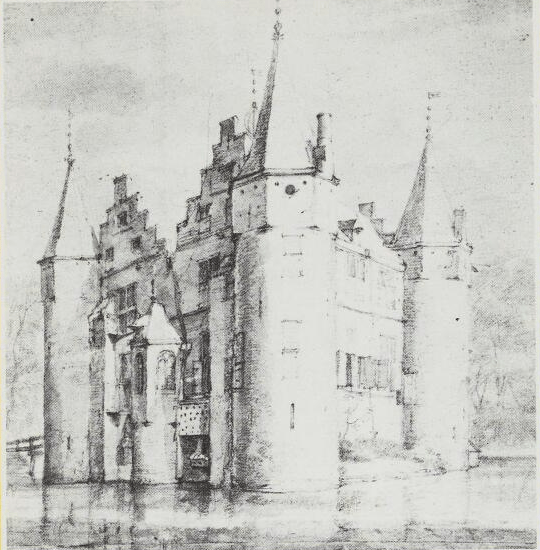
Digging through the Barrepolder, construction crews uncovered the remains of Huis te Zwieten — a moated medieval castle whose lineage traced back to a fiefdom granted in 1312, once the seat of a locally well-known noble family. The castle itself had been demolished back in 1805, its stone reportedly recycled into the road to The Hague — but its foundations and moat outline were still there, waiting underground. Alongside it, archaeologists from the national antiquities service turned up traces of Roman-era settlement too, though those finds only received a light once-over before construction pressed on.
Building at a Pace That Bordered on Reckless
The first pile went into the ground on 22 November 1971, driven by adjunct-director ir. J.M. van Rossem in a ceremony that drew a genuinely curious crowd from Zoeterwoude itself.
What followed was not a gentle build. The polder’s soft ground demanded serious reinforcement — 3,562 prefabricated concrete piles, ranging from 16 to 20 metres deep and each rated to carry 60 tonnes, plus another 490 steel piles rated at 120 tonnes apiece for the heaviest structures: the beer cellar and the silo building.
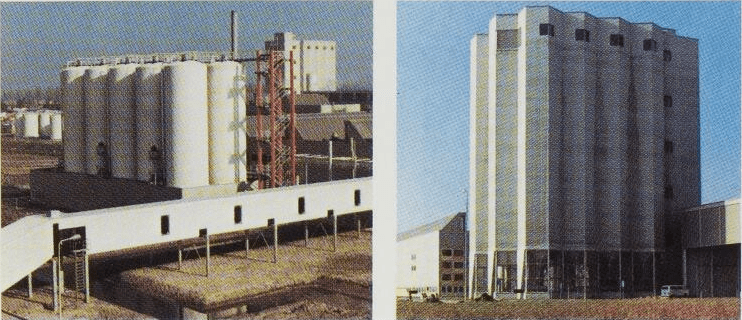
That silo building deserves its own paragraph. On 7 October 1972, it reached its full height of 39.85 metres — the tallest structure on site — built using a continuous climbing-formwork technique that ran, without stopping, for thirteen straight days and nights. The result was a striking honeycomb structure: sixteen hexagonal storage cells arranged like a beehive at each corner, a design chosen as much for its visual impact as its function.
Life kept arriving alongside the concrete. On 28 February 1973, director-secretary Mrs E. Wessels-Mager planted the very first tree on site — a Prunus avium, a sweet cherry — kicking off a landscaping effort that would eventually add another thousand trees, forty-two thousand shrubs, and eight hundred additional plants around the industrial buildings. By mid-1973, ships were arriving loaded with the brewery’s first equipment: 88 half-sized lager tanks and 10 enormous fermentation vessels, some running 22 metres long and holding 4,000 hectolitres apiece.
On 7 March 1974, the first tanker truck loaded with beer — 314 hectolitres of it — rolled out toward Rotterdam, marking the moment bottling could finally begin. Two days after that, buyers received the very first hundred thousand 30cl bottles filled on-site. By September 1974, the first full brew produced entirely at Zoeterwoude was ready to drink.
Seven months later, the brewery was ready to open its doors to the public.
Designed Around a Windmill and a Stream
The architectural team of Van den Broek en Bakema didn’t try to fight the landscape — they built around it. The Weipoortse Vliet stream and the Oude Rijn river, both natural boundaries of the site, were preserved rather than paved over, and the historic identity of the “Barremolen” windmill — long gone from the physical landscape, demolished centuries earlier in 1657, but clearly still meaningful enough locally to be woven into the site’s character — was carried through in spirit rather than ignored.
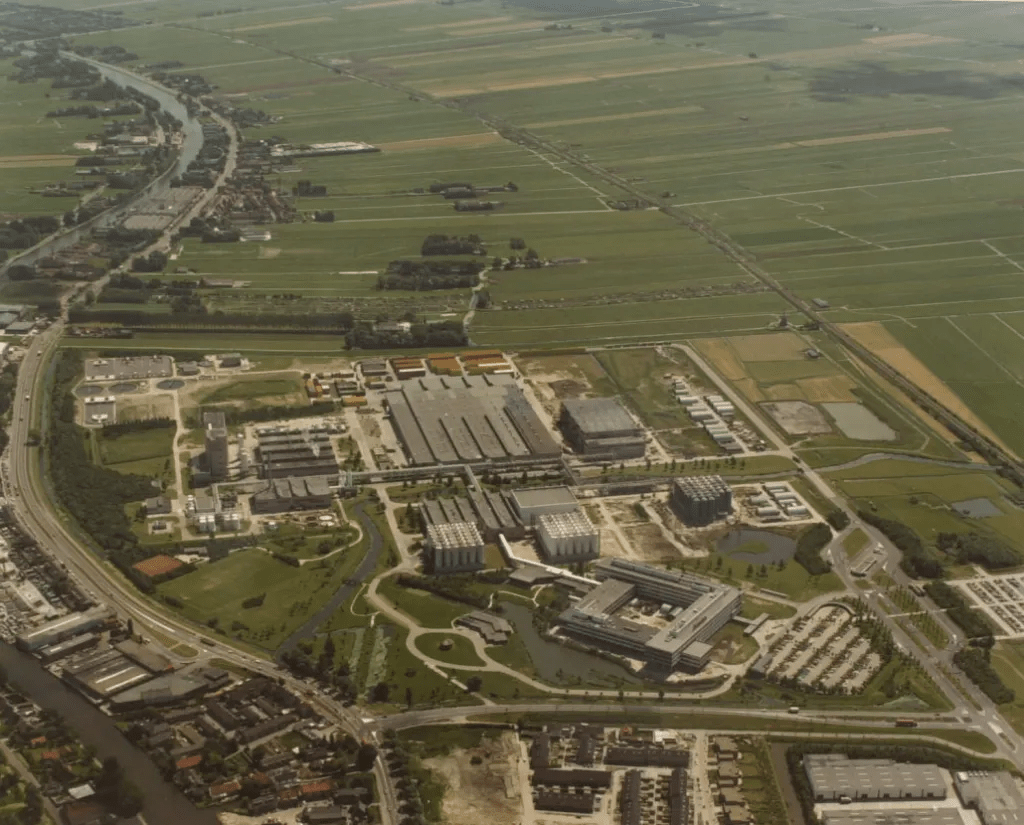
The finished complex covers 7.5 hectares of a much larger 78-hectare plot, deliberately leaving enormous room for growth — the brewery’s own master plan reportedly allowed for as much as a tenfold expansion in production capacity over time, built in phases as needed. Everything on site sits on a strict 1.20 by 1.20 metre structural grid, and the whole thing runs on steel — some 5,100 tonnes of it holding up buildings with 24-metre-wide unsupported spans, a genuinely ambitious engineering choice for the time.
Even the finishing touches got real thought: ceramic tile accents in orange-red, yellow and blue break up the facades, the fermentation tanks earned the nickname “Apollo’s” among staff (probably from their tall, rocket-like verticality), and the office building’s round windows were placed specifically so people inside could take in the view across the Weipoortse Vliet rather than stare at a blank wall.
The Day Itself
Prince Bernhard arrived by car at eleven that morning, greeted by a small welcoming committee that included Heineken’s own Raad van Bestuur chairman, A. H. Heineken, and Zoeterwoude’s mayor, J. A. Detmers. After signing the guestbook and being introduced to the rest of the board, the Prince was led into a hall specially converted for the occasion — walled off using stacked crates and curtains — where some 400 invited guests were already seated.
Heineken opened with a simple welcome: “Koninklijke Hoogheid, mijnheer de commissaris der Koningin, mijnheer de burgemeester, dames en heren. Het is mij een voorrecht u allen hier vanmorgen van harte welkom te mogen heten bij de officiële ingebruikneming van onze nieuwe brouwerij te Zoeterwoude.” — a privilege, he said, to welcome everyone to the official opening of the new Zoeterwoude brewery.
The Prince didn’t just make small talk either — his own remarks apparently included a few pointed observations about government policy, and a broader discussion followed among the board about the realities of long-term industrial planning: five years as an absolute commercial minimum, technical planning stretching further still, all shadowed by the era’s inflation and fiscal write-off rules. Heavy topics for an opening party, but clearly ones very much on everyone’s mind in 1975.
Mayor Detmers, by contrast, brought the lighter touch — a warm, witty speech recalling how “Barrepolder” had already been affectionately renamed “Bierpolder” by the locals, and admitting his early worry that the brewery might steamroll the town’s character. Instead, he said, the brewers had proven to be careful, considerate builders, and the jobs the brewery brought were foundational to the town’s welfare going forward.
Then came the moment everyone was waiting for: the official opening itself. The mayor presented Heineken with a miniature golden cradle as a table piece for the town council chamber — commemorating a local legend attached to the site. Heineken pressed a button, the lights dropped, and newsreel footage played on a big screen — including, delightfully, a shot of a beer tanker truck seemingly filmed driving straight into the hall itself, to the crowd’s evident amazement.
Heineken poured the Prince the very first beer served at the new brewery, and the two men drank a toast together. The Heineken Fanfare band struck up the company’s well-known jingle — “Heerlijk, Helder, Heineken” — parading through the hall alongside their mascot, the Heineken goat, while Prince Bernhard and Heineken looked on.
After lunch and a guided bus tour of the grounds — including a stop at the brewery’s own wastewater purification plant, sized to handle the sewage load of a city of 120,000 people, at a cost of 20 million guilders — the Prince departed by helicopter once the morning mist had cleared, leaving the afternoon free for commercial guests and the wider public to explore the brewery that had, four years and one buried castle earlier, been nothing but empty polder land.
The opening of Zoeterwoude marked far more than a simple relocation. It symbolized Heineken’s shift from traditional urban brewing to modern, highly efficient, large-scale production. Built to supply both the domestic market and a growing international export system, Zoeterwoude became one of the key engines behind Heineken’s worldwide expansion. From this site, beer production helped support a network that now reaches around 180 export countries.
As the largest brewery in Europe, Zoeterwoude stands as one of the most important physical symbols of Heineken’s transformation from a Dutch brewer into a global brewing company.