At a glance
- Year: 1986–1988
- Location: Amsterdam
- Story status: Confirmed
Who and where
Connected to
- Featured beers:
The Last Brew (1987–1988)
Every brewery has a first batch. Not many get to have a documented, deliberate, toasted-to-on-purpose last one.
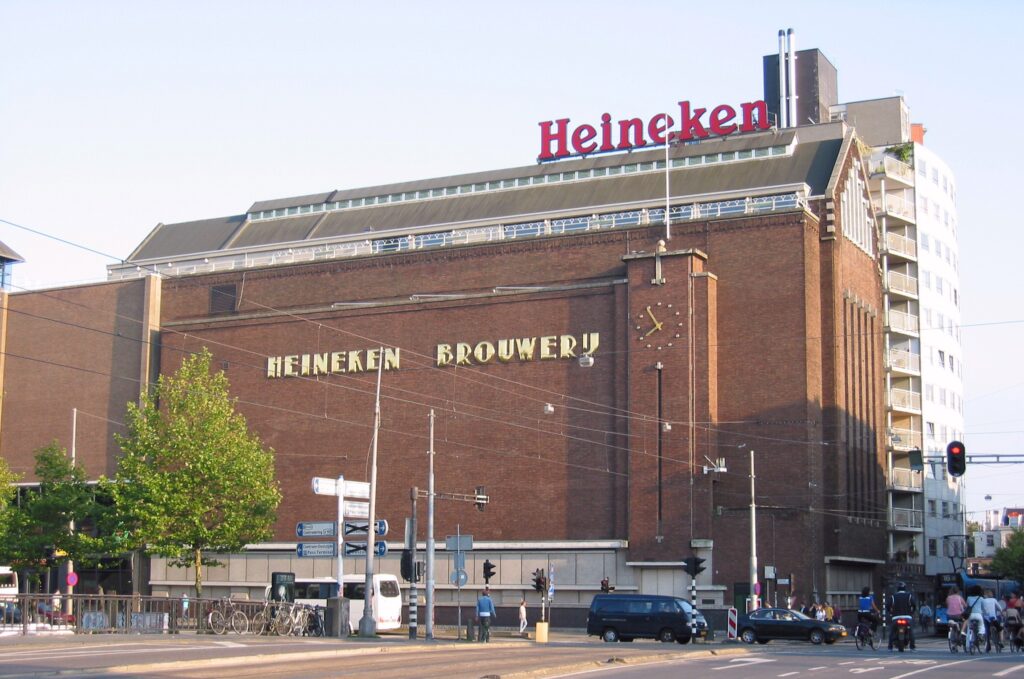
On 30 December 1987, just days before the new year, the copper kettles at Amsterdam’s Stadhouderskade brewery were filled one final time. It was the last brew the site would ever produce — the end of a run that had started exactly 120 years earlier, on 22 January 1868, when Gerard Heineken himself presented the very first batch from this same steam brewery, designed by architect Isaac Gosschalk.
The beer brewed that final December day needed time to condition before anyone could actually drink it. So it sat, quietly maturing, while the brewery around it prepared to say goodbye.
A Pun Only Amsterdam Could Make
The farewell beer needed a name, and whoever landed on this one deserves a round of applause. It was called Normaal Amsterdams Pils — a cheeky play on Normaal Amsterdams Peil, the official Dutch reference level for measuring sea level and elevation across the entire country, a term so woven into Dutch daily life that most people know the abbreviation “NAP” without ever thinking about what it stands for. Swap “Peil” for “Pils,” and you’ve got a beer name that’s a small, proud joke only Amsterdam could tell about itself.
It wasn’t a weak parting gesture either. This farewell brew came in noticeably stronger than the standard pils, with an original wort gravity of around 14 degrees — a richer, fuller beer than the everyday product, made for an occasion that deserved a bit more weight.
Two Farewells, Close Together
By April 1988, the beer was ready — and so, reluctantly, was everyone else.
On 22 April, around seven hundred people gathered at Van der Helststraat to say their goodbyes — to colleagues, and to the brewery itself. It was, by all accounts, a genuinely warm occasion. Former Amsterdam employees who’d drifted apart over the years found each other again, falling into easy conversation, holding onto a mood that felt, if only for one evening, like old Amsterdam hadn’t gone anywhere at all. Fifty-three employees said their collective farewell that day — and everyone in attendance went home with a set of bottled Brouwsel 1466 to keep.
Somewhere close to that same date, staff and board members also gathered separately in the brewery’s Koelschip — the coolship, once used to cool the wort after boiling — to raise a glass together on site. The beer in that glass was the very last one those copper kettles would ever produce: brew number 1466. The final entry in a very long ledger.
The 53 departing employees weren’t quite done marking the occasion either. On Friday 6 May, they went on one last outing together — a boat trip on the Mississippi Queen, sailing off into their next chapters as a group rather than scattering quietly.
Why It Had to Happen
None of this came from a lack of love for the place. It came from simple, unglamorous arithmetic.
Rotterdam’s Heineken brewery had already gone through the same thing back in 1975, its staff moving to a brand-new, purpose-built facility in Zoeterwoude. Amsterdam was, by the late 1980s, facing the identical problem: a beautiful, more-than-century-old city-center brewery, increasingly squeezed by traffic, transport logistics, and a building that simply wasn’t built for the scale Heineken now operated at. Modernizing it in place would have cost a fortune for a building that, however beloved, could never be as efficient as something built fresh on the outskirts. The era of the city-center brewery, as Heineken itself put it, had simply come to an end.
Reactions varied wildly, as you’d expect from something this significant. For a handful of the older staff, the closure became a natural moment to simply stop — why start over somewhere new, after a lifetime here? Others took the opposite view entirely, treating Zoeterwoude as a genuinely exciting next chapter rather than a loss. And a fair number were just plain angry about the whole thing, no nuance needed. But cutting across all of that, there was one feeling almost nobody escaped: a quiet ache for a building that had absorbed well over a hundred years of memory, however rose-tinted some of those memories might have become with time.
Freddy’s Line in the Sand
Freddy Heineken felt it too.
By his own account, he struggled with the goodbye as much as anyone. And he said so, plainly: “Ik wil wel gewoon wat houden van de brouwerij hier” — “I do want to keep something of the brewery here.”
That single sentence, backed by the brewery’s enormous popularity with tourists even while it was still operational, is the reason the Stadhouderskade buildings weren’t simply demolished the way Rotterdam’s largely were. The old brewhouses, the malt silos, and the huge fermenting cellar building were all preserved. The brewhouse itself was earmarked for something new: a visitor centre. The building that would, a few years later, become the Heineken Experience.
At the time of the farewell itself, though, nothing was fully settled yet — plans for the site’s eventual future were still being worked out, with several parties involved and no final answer yet in hand.
Selling the Machines, Keeping the Memory
Practically speaking, the closure meant exactly what you’d expect: the bottling lines and most of the working inventory were sold off. But the decision was made early to hold onto the buildings themselves as a “special reception facility” — with early projections already anticipating some 150,000 visitors a year, many of them American tourists drawn to the authentic Heineken atmosphere.
Renovation work began in May 1989. It wasn’t entirely smooth — a fire broke out on site on 23 November that year during construction, though the damage stayed limited and didn’t derail the project. New stables were even built for the delivery horses, who would return to Stadhouderskade in 1991 from their temporary home on Quellijnstraat, becoming part of the visitor route themselves — no longer hauling beer through the city, just walking it for show.
By July 1990, the first guests were welcomed through the doors. The formal opening as the Heineken Reception and Information Centre followed on 22 May 1991 — setting up everything that would, a decade later, become the Heineken Experience.
What Brouwsel 1466 Really Was
It’s tempting to think of Brouwsel 1466 as just a beer. It wasn’t, really. It was a full stop at the end of a 120-year sentence — a little stronger than usual, named after a joke about sea level, brewed on purpose, aged on purpose, and shared on purpose by the people who’d spent their working lives making sure Heineken’s beer left that building tasting exactly the way it should.
The brewing stopped that day. But thanks to one man who refused to let go entirely, the building never really did.